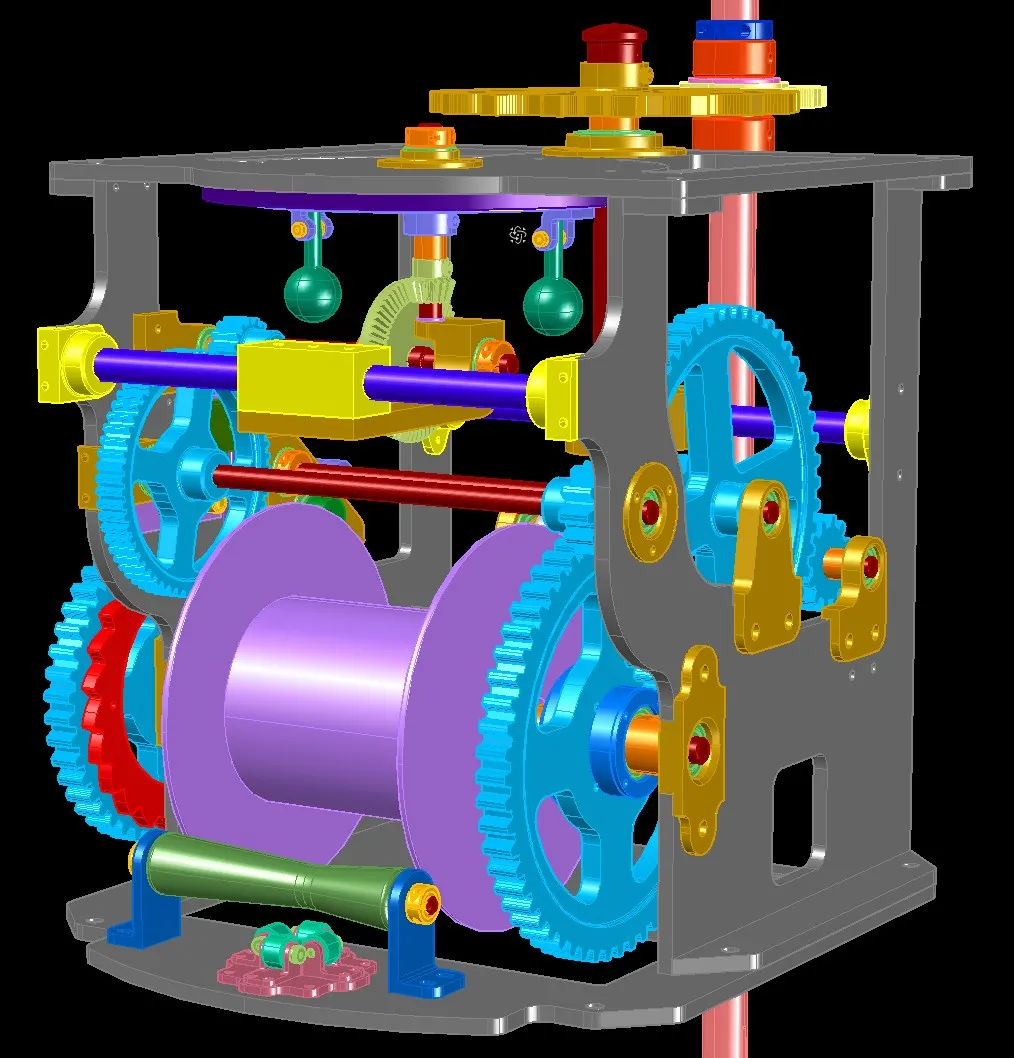
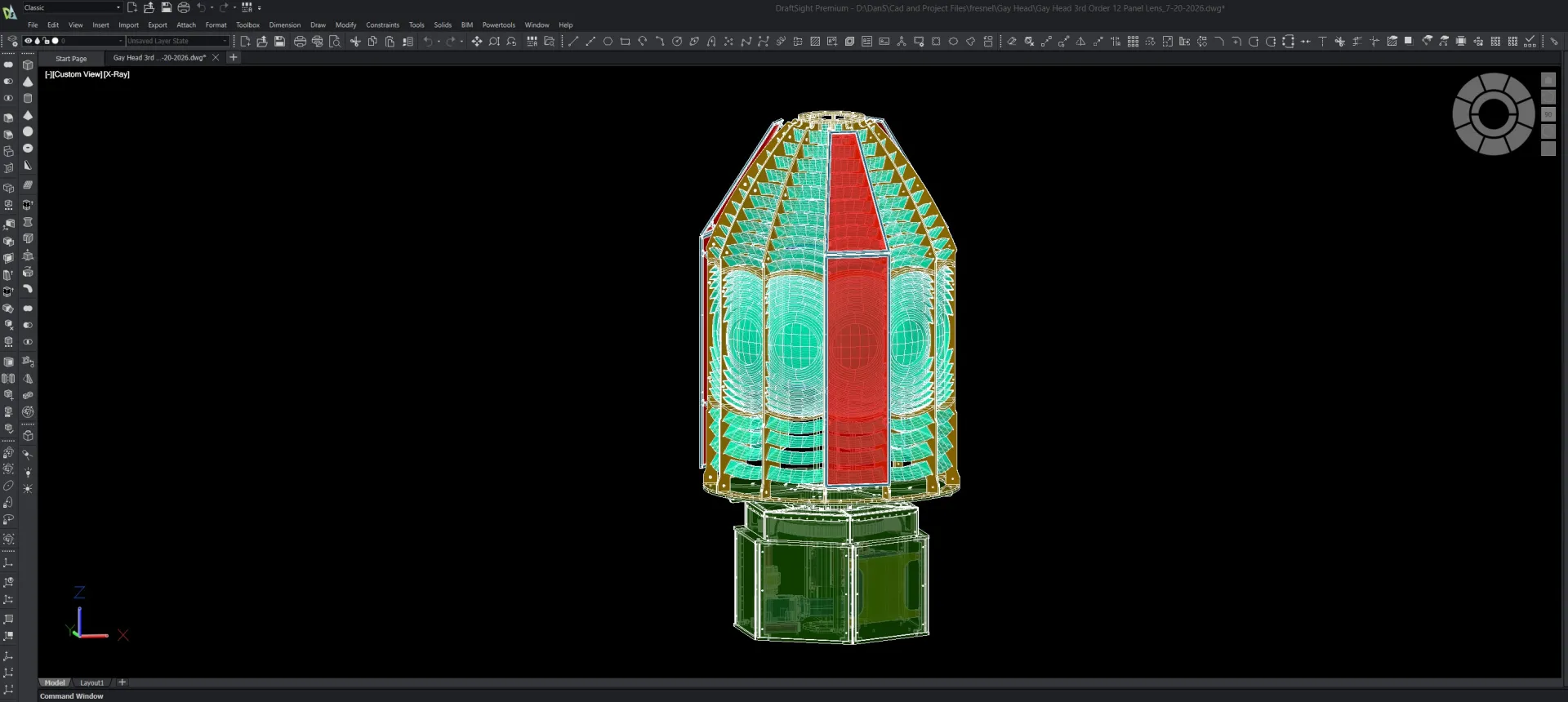
What began as an act of volunteer community service for former Disney Mechanical Designer Dan Spinella — to restore the Fresnel lens in the St. Augustine Lighthouse in Florida — has blossomed into a growing business focused on preserving, restoring, and reproducing historic Fresnel lighthouse lenses. Invented by Frenchman Augustin Fresnel in 1822, Fresnel lenses use a central magnifying bull’s-eye surrounded by concentric rings of prisms instead of a thick, heavy, curved piece of solid glass. The curved prisms bend and catch light rays that would normally escape upward or downward, pulling them into a tight, intense, concentrated beam that is visible to ships at sea.
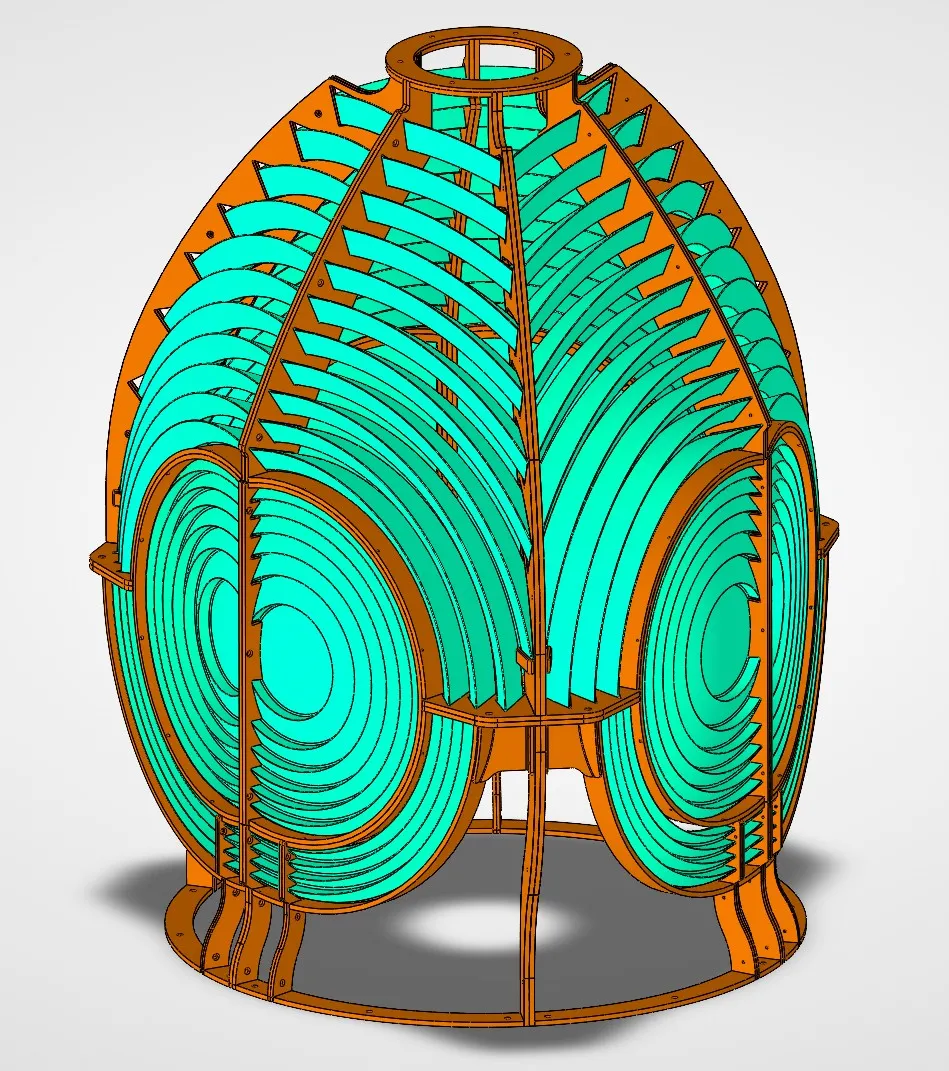
Using DraftSight 2D/3D design software in conjunction with SOLIDWORKS for Makers software, Artworks Florida can create dazzling photorealistic renderings, such as the Punta Tuna third order bivalve lens shown here.
Fresnel lenses are widely used in lighthouses all over the world, and Spinella, owner and mechanical designer at Artworks Florida Classic Fresnel Lenses, LLC, first got involved in restoring and reproducing Fresnel lenses in 1992 when he volunteered to restore the first-order classic lens in the St. Augustine lighthouse. “The lens was vandalized in the late 1980s when someone shot it with a rifle, breaking 13 prisms, and the U.S. Coast Guard was scheduled to dismantle and remove the lens from the tower,” Spinella recalls. “The Junior Service League of St. Augustine promised to raise the funds and find a way to restore the lens if they would be allowed to keep their historic lens in the tower. The lens was successfully restored and relit one year later, with many people, including myself, giving their time to the effort.”
The project led Spinella, who retired from Disney Engineering in 2025 after 36 years designing Disney World rides, animatronics, and attractions, to found his Fresnel lens restoration company following the St. Augustine Lighthouse restoration. Since then, Artworks Florida has handled many Fresnel lens restoration projects around the United States, such as the work on the lenses used at the Ponce Inlet Lighthouse and the Cape Hatteras Lighthouse.
By 2003, Artworks Florida had grown to the point at which the design and production of full-scale reproduction lenses, rather than restored lenses, began. Reproduced lenses are used as interpretive exhibits in museums and as private aids to navigation in many lighthouses around the country. As of mid-2026, Artworks Florida has produced 55 lenses of all sizes. Until recently, Spinella used the AutoCAD® 2D/3D design tools that he had used in his work at Disney. However, after seeing a DraftSight design software presentation, Spinella realized that DraftSight would provide a more efficient and more affordable design solution for managing his growing lens restoration business while also maintaining access to his valuable legacy data and 3D design and visualization capabilities.
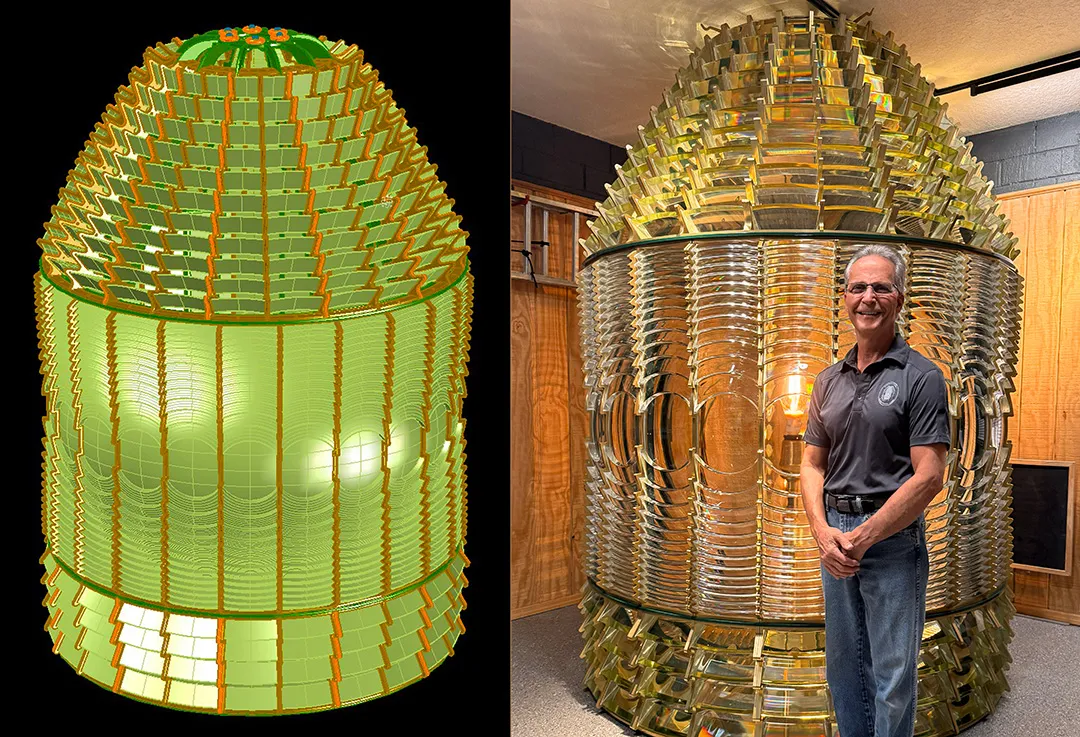
The first project that Dan Spinella of Artworks Florida used DraftSight for was the lens for the granddaddy of all lighthouses. At 198.49 feet tall, the Cape Hatteras Lighthouse is widely recognized as the tallest brick lighthouse in the United States.
Artworks Florida acquired DraftSight Premium 2D/3D design software in 2025 because not only is the software more affordable at roughly one-fourth the cost of AutoCAD, but also because it operates just like AutoCAD and opens all AutoCAD legacy data files. When combined with the firm’s SOLIDWORKS for Makers software, DraftSight enables Spinella to create dazzling photorealistic renderings of his projects, which improve visualization and communication across restoration teams.
“What drew me to DraftSight was the ability to model in 3D and the fact that it costs a lot less, which is a huge advantage,” Spinella explains. “What won me over was the fact that it operates just like AutoCAD and required no training — you can even type in AutoCAD commands and DraftSight will show you the same command in DraftSight — and I can open all of my previous AutoCAD files, which maintains the value in my legacy data.”